Open Nav


The automotive industry's transformation is accelerating, and at the center of that transformation is electronics. From the transition to electric powertrains to the proliferation of advanced driver assistance systems, the demands placed on pcb assembly services in the automotive sector have never been more complex or more consequential. A Pcb failure in an automotive application is not just a quality issue; it is a safety issue. This reality shapes every aspect of how automotive pcb assembly is specified, manufactured, tested, and delivered. Understanding the trends driving this sector in 2026 helps engineers, procurement professionals, and product managers make better decisions about their Pcb Assembly partnerships.

Electric vehicles have fundamentally changed the electronics content of the automobile. The internal combustion engine, with its mechanical complexity and relatively simple electronics, is being replaced by drivetrains that are essentially power electronics systems. The inverter that converts DC battery power to AC motor drive, the onboard charger that manages battery charging, the DC-DC converter that distributes power throughout the vehicle, and the battery management system that monitors and balances cell voltages all depend on PCBs that must handle high currents, manage extreme thermal conditions, and operate with extreme reliability over the life of the vehicle.
Pcb Assembly services serving the EV market have had to evolve their capabilities significantly to meet these requirements. High-current bus bar assemblies, which distribute hundreds of amperes of current throughout the powertrain, require thick copper substrates, heavy plating, and often custom press-fit or welded connections that go well beyond the capabilities of standard Smt Assembly. Thermal Management is critical; power modules in EV applications routinely generate tens of kilowatts of heat that must be conducted away through the Pcb substrate, often using direct bonded copper substrates or specialized IMS (insulated metal substrate) constructions.
Reliability expectations in the EV market are measured in decades rather than product cycles. Automotive OEMs require failure rates measured in parts per million across the operating life of the vehicle, which typically means 15 to 20 years of operation under extreme thermal cycling, vibration, and humidity conditions. Meeting these reliability targets requires process controls, material selection, and testing protocols that are far more stringent than those used for consumer Electronics Assembly.
The proliferation of ADAS features across vehicle lineups has created a new category of PCB assembly challenges. Radar modules, cameras, lidar systems, and ultrasonic sensors all depend on PCBs that operate at high frequencies, often in the 77 GHz to 79 GHz range for automotive radar, and must maintain signal integrity in environments that include vibration, thermal extremes, and electromagnetic interference from the vehicle's own power systems.
Radar PCB assembly for automotive applications requires specialized materials, typically automotive-grade Rogers laminates or similar high-frequency substrates, that maintain consistent dielectric properties across temperature and frequency. The antenna structures within radar modules require precise fabrication tolerances because the beam pattern, detection range, and angular resolution of the radar are all directly determined by the physical geometry of the antenna traces on the PCB. Even small dimensional variations can degrade radar performance, which means the assembly service must have process controls that are tighter than those needed for standard digital assemblies.
Camera modules present their own set of assembly challenges. High-resolution automotive cameras, which are increasingly used for surround view, rear view, and machine vision applications, require image sensors that are assembled with extremely precise alignment. The flex PCBs that connect image sensors to processing modules must survive the vibration and thermal cycling environment of a vehicle while maintaining signal integrity at the high data rates required for uncompressed video transmission. Assembly services that handle automotive camera modules need specialized bonding equipment, inspection capabilities, and handling procedures that protect the sensor during the assembly process.
For any PCB Assembly Service targeting the automotive market, Iatf 16949 certification is essentially a prerequisite. This standard, which replaced ISO/TS 16949 in 2016, defines the Quality Management system requirements for organizations involved in the automotive Supply Chain. It is not merely a badge; it is a comprehensive framework that governs every aspect of how an assembly service operates, from incoming material inspection to process control to customer feedback and corrective action.
What Iatf 16949 demands in practice goes beyond a quality manual and a certification audit. It requires statistical process control for critical assembly parameters, documented procedures for every process step, traceability from finished assembly back to individual component lots, and regular internal audits that verify the quality system is functioning as documented. For automotive customers, these requirements are non-negotiable because they are the foundation of the traceability and reliability expectations that automotive OEMs impose on their Supply Chain.
In 2026, the bar for automotive Quality Certification continues to rise. Several major automotive OEMs have introduced additional requirements that go beyond IATF 16949, including specific process capability requirements for critical assembly parameters, mandatory use of specific testing methodologies, and audit requirements that extend beyond the standard IATF schedule. Pcb Assembly Services that want to remain competitive in the automotive market must not only maintain their IATF 16949 certification but continuously improve their quality systems to meet the evolving expectations of their automotive customers.
As vehicles add more electronic features, the available packaging space for those features does not increase proportionally. Automotive Electronics modules are becoming smaller and more densely populated, which creates assembly challenges that are comparable to those in consumer electronics, but with the added constraint that automotive modules must meet far more stringent reliability requirements. A 0201 or 01005 passive component that is acceptable in a consumer product may be used in an automotive module, but the assembly process must achieve first-pass yields that are higher than consumer standards to meet the overall reliability targets.
Miniaturization in automotive applications is also being driven by the consolidation of functions into single modules. Rather than separate ECUs for each subsystem, automotive OEMs are consolidating multiple functions into domain controllers that handle body, chassis, powertrain, and infotainment domains from a single compute platform. These consolidated modules have PCB designs with extremely high component density, complex multilayer stackups with many internal routing layers, and thermal challenges that require careful thermal simulation and often active cooling solutions.
Assembly services supporting these high-density automotive modules need capabilities that include fine-pitch component placement, multi-level assembly processes for packages like PoP (package-on-package), and X-ray inspection for Bga and Qfn packages that are not inspectable by visual methods alone. The investment in these capabilities is significant, and the automotive assembly services that have made that investment are increasingly differentiated from those serving only consumer or industrial markets.
The semiconductor shortages that disrupted automotive production from 2020 through 2023 left a lasting imprint on how the industry manages component supply chains. Automotive OEMs and their tier-one suppliers have moved aggressively to secure long-term supply agreements with semiconductor manufacturers, to qualify second-source components for critical applications, and to regionalize their supply chains to reduce the risk of geographic disruptions.
Pcb Assembly Services are affected by these supply chain shifts in several ways. First, component availability planning has become a more integral part of the assembly service relationship. Services that can offer component forecasting, buffer stock programs, or long-term supply agreements are more attractive to automotive customers than those that simply procure to order. Second, the regionalization trend is driving investment in new automotive assembly capacity in North America and Europe, which is reshaping the competitive landscape for Automotive Pcb Assembly services globally.
In 2026, the trend toward supply chain localization continues to accelerate, driven by both trade policy considerations and the practical need for Supply Chain Resilience. Automotive OEMs are increasingly specifying domestic or regional content requirements for electronics assemblies, which means assembly services must source components from qualifying suppliers and document the supply chain provenance of every significant material in the assembly. This adds administrative complexity but also creates opportunities for assembly services that have invested in the systems and processes needed to manage these requirements.
Automotive Pcb Assembly testing goes far beyond what is typical in consumer or even Industrial Electronics. The testing pyramid for automotive assemblies typically includes Visual Inspection, Automated Optical Inspection, X-ray inspection for hidden solder joints, in-circuit testing to verify component placement and solder connections, functional testing to verify the assembled module performs its intended function, and often environmental stress screening to identify early-life failures before the assembly ships to the customer.
The specific testing requirements for an automotive assembly are defined by the automotive customer, typically in an interface control document or Quality Assurance specification that references industry standards like AEC-Q100 for components and AEC-Q200 for passive components. The assembly service must demonstrate the ability to perform the required tests, maintain calibrated test equipment, and document test results in a format that supports the traceability requirements of the automotive quality system.
One significant trend in automotive testing is the increasing use of Boundary Scan and functional test for complex digital assemblies. As automotive control modules incorporate more complex integrated circuits, traditional in-circuit testing becomes less feasible because the internal logic of modern ICs cannot be probed through simple test points. Boundary Scan testing, which leverages the JTAG interface built into most modern ICs, provides a way to verify the integrity of connections between ICs without physical probe access. Functional testing, which verifies that the assembled module performs its intended function in a test fixture that simulates the vehicle environment, is increasingly required for safety-critical modules like airbag controllers and brake-by-wire systems.
Sustainability has moved from a peripheral concern to a central consideration in automotive Electronics Supply Chain decisions. Automotive OEMs have committed to reducing the environmental footprint of their supply chains, and these commitments are flowing down to tier-one suppliers and further into the Electronics Assembly supply chain. PCB assembly services are being asked to report on energy consumption, waste generation, and water usage, and to demonstrate continuous improvement in environmental performance metrics.
The push toward Lead-free Assembly in automotive applications, which was driven by regulatory requirements like RoHS, has created ongoing challenges in solder joint reliability that the industry continues to manage. Lead-free solders have different mechanical properties than tin-lead solders, including higher tin whisker risk and different thermal cycling characteristics. Automotive assemblies that use lead-free finishes must be designed and assembled with these differences in mind, and the assembly service must have process controls that are optimized for Lead-free Assembly rather than simply applying a lead-free finish to a process designed for tin-lead.
Material traceability requirements in automotive assembly now extend to Environmental Compliance documentation. The IMDS (International Material Data System) database, which has been used for years to track materials in automotive assemblies for recycling and end-of-life management, is increasingly being used to verify compliance with REACH, RoHS, and other environmental regulations. Assembly services must maintain detailed material declarations for every component in an assembly and be able to provide this documentation to customers on request.
The automotive PCB assembly market in 2026 is being shaped by the convergence of several powerful trends: the electrification of the powertrain, the expansion of ADAS capabilities toward autonomous driving, the continuing pressure to miniaturize and consolidate electronic functions, the imperative of Supply Chain Resilience, and the growing focus on environmental Sustainability. Each of these trends creates specific capability requirements for assembly services, and the gap between assembly services that can meet these requirements and those that cannot continues to widen.
For engineering teams and procurement professionals selecting an automotive Pcb Assembly Partner, the implications are clear. The lowest-cost quote from an assembly service that lacks IATF 16949 certification, automotive-specific process capabilities, and demonstrated reliability in high-volume automotive production is likely to cost more in the long run through quality escapes, supply disruptions, and the engineering time required to manage an underperforming supplier. Investing in a strong assembly partnership from the beginning of a program typically delivers better outcomes than switching suppliers mid-program or managing quality issues in production.
The Automotive Electronics market will continue to grow as vehicle electronics content increases. Assembly services that have invested in the capabilities needed to serve this market, that maintain their quality systems at the level automotive customers expect, and that can demonstrate supply chain resilience and long-term partnership commitment will capture a disproportionate share of that growth. The trends shaping 2026 are not temporary; they represent a structural shift in what the automotive industry requires from its Electronics Supply Chain, and that shift will define the competitive landscape for years to come.
Contact us to discuss your requirements.
What is the difference between Surface Mount Technology (SMT) and through-hole assembly?June/04/2026
Enhancing Product Lifespan with Advanced Cleaning and Coating SolutionsAugust/06/2026

China's Role in the Global PCB Assembly Ecosystem: A 2026 UpdateAugust/11/2026
Managing Moisture Sensitivity Levels (MSL) for BGA and QFN PackagesAugust/10/2026
Turnkey vs. Consignment PCB Assembly: Which Model Fits Your Project?August/08/2026

The Growing Importance of Traceability and Blockchain in PCBAAugust/12/2026
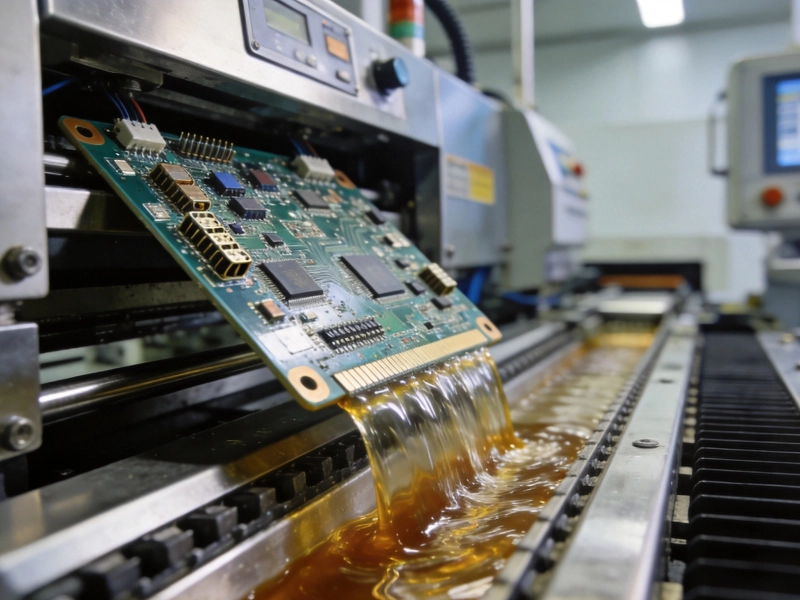
A Simple Explanation of Wave Soldering for Mixed-Technology BoardsJuly/22/2026

How to Read an IPC-A-610 Standard for Electronic AssembliesSeptember/08/2026