

Manufacturing printed circuit board assemblies used to be a game of experience and intuition. Veteran process engineers could walk the production floor, look at solder joints, listen to pick-and-place machines, and diagnose problems before they became defects. That expertise still matters—but today, it's being amplified by artificial intelligence in ways that are transforming yield rates and Manufacturing economics.
Smart factories aren't just about robots and automation. They're about data—massive amounts of it—analyzed by Machine Learning algorithms that spot patterns human inspectors can't see, predict failures before they happen, and optimize processes in real-time. For Pcba manufacturing, where defect rates directly impact profitability and quality, AI-driven manufacturing is becoming a competitive necessity.
This article explores how artificial intelligence is being applied throughout the Pcba manufacturing process, what results smart factories are achieving, and what this means for manufacturers and their customers. The transformation is real, it's happening now, and the yield improvements are measurable.
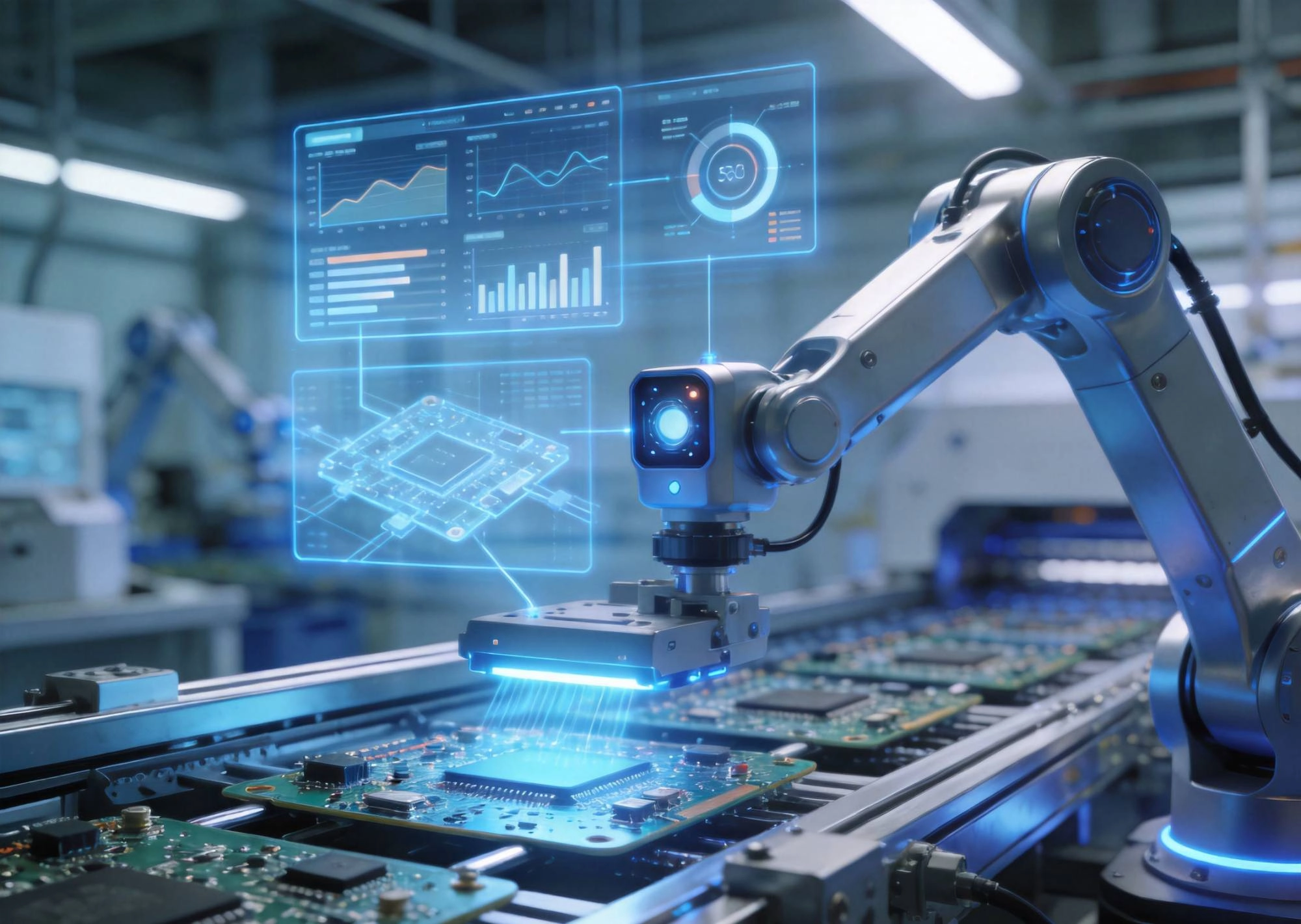
AI requires data—lots of it. Smart factories generate terabytes of data daily from sensors, inspection systems, process equipment, and Quality Control checkpoints. Every Solder Paste print, every component placement, every reflow profile, every AOI scan produces data that feeds Machine Learning systems.
The difference between a traditional factory and a smart factory isn't just having this data—it's using it. Traditional factories collect data for compliance and traceability, then store it in databases where it sits largely unused. Smart factories feed this data continuously into analytical systems that extract insights and drive improvements.
Modern PCBA manufacturing generates data across the entire production process:
Each of these data streams alone provides limited insight. Combined and analyzed with machine learning, they reveal relationships between process parameters and quality outcomes that weren't previously visible.
Smart factories implement what's called a "digital thread"—a continuous data record that follows each product from design through manufacturing to testing. This thread connects design decisions (component selection, pad geometries, layout) to manufacturing outcomes (defect rates, test yields, field reliability).
The digital thread enables root cause analysis that spans the entire production process. When a defect appears, engineers can trace back through the data to identify exactly when and where the problem originated, what process parameters were involved, and which other products might be affected. This traceability is essential for continuous improvement and for managing quality in complex manufacturing environments.
Automated Optical Inspection (AOI) has been standard in PCBA manufacturing for decades. Traditional AOI uses rule-based algorithms—engineers program specific criteria for what constitutes a defect, and the system flags anything matching those criteria. This approach works but has limitations: it's brittle, requires constant tuning, and generates false positives that waste engineering time.
Machine learning-based AOI represents a fundamental improvement. Instead of explicit rules, these systems learn from examples. Engineers train the system with labeled images—thousands of examples of good solder joints and defective ones. The neural network learns to recognize patterns that distinguish good from bad, often detecting subtle defects that rule-based systems miss.
Machine learning inspection systems typically use convolutional neural networks (CNNs), which are particularly good at image analysis. The training process involves:
The key advantage is adaptability. When a new defect type appears, engineers simply label examples and retrain the model. Rule-based systems require programmers to develop new detection algorithms—a much slower process.
Factories implementing machine learning AOI report significant improvements in defect detection rates. False negative rates (missing real defects) drop by 30-50% compared to rule-based systems. Equally important, false positive rates (flagging good parts as defective) also decrease, reducing the engineering overhead of reviewing and dispositioning flagged boards.
Some advanced systems go beyond simple pass/fail classification. They predict defect severity—distinguishing between cosmetic issues and functional problems—and can even suggest process adjustments to prevent similar defects from recurring.
Equipment failures cause significant yield loss in PCBA manufacturing. A pick-and-place machine dropping components, a reflow oven with temperature zone issues, or a stencil printer with alignment drift can all produce hundreds of defective boards before the problem is detected and corrected.
Predictive Maintenance uses machine learning to identify equipment degradation before it causes defects. By analyzing sensor data from machines—vibration patterns, motor currents, temperature profiles—AI systems learn the signatures of healthy equipment and detect subtle deviations that indicate impending problems.
Traditional maintenance schedules are either time-based (service equipment every X hours) or reactive (fix it when it breaks). Time-based maintenance is wasteful—replacing parts that still have life. Reactive maintenance is costly—fixing problems after they've caused defects.
Predictive Maintenance strikes the optimal balance. AI models analyze equipment performance data to predict when specific components will need attention. Maintenance happens just before failure, minimizing both unnecessary maintenance and defect-causing breakdowns.
Smart factories implementing predictive maintenance report 20-40% reductions in unplanned downtime and corresponding improvements in overall equipment effectiveness (OEE). For high-volume production, this translates directly to yield improvements and cost savings.
Beyond maintenance, AI systems optimize process parameters in real-time. Solder Paste Printing, for example, involves multiple variables: stencil aperture size, squeegee pressure, print speed, separation speed, paste temperature. The optimal settings vary with environmental conditions, paste age, and board characteristics.
Machine learning models analyze the relationship between process parameters and print quality outcomes, then adjust parameters automatically to maintain optimal performance. If humidity increases and paste starts behaving differently, the system detects the change and compensates—often before human operators would notice a problem.
Similar optimization applies to reflow profiling, where AI systems adjust zone temperatures and conveyor speeds to maintain ideal thermal profiles despite variations in board load, component density, and ambient conditions.
When defects occur, finding root causes quickly is essential. Traditional root cause analysis relies on engineering expertise and systematic investigation—effective but time-consuming. AI accelerates this process by analyzing vast datasets to identify correlations that point to root causes.
Machine learning excels at finding patterns in high-dimensional data. In PCBA manufacturing, defects might correlate with dozens of variables: time of day, operator shift, specific feeder, humidity levels, component batch, paste age, and so on. Humans struggle to hold all these variables in mind simultaneously; machine learning systems analyze them all.
For example, an AI system might discover that solder void defects spike when using components from a specific supplier lot during afternoon shifts when humidity is above 60%. This specific combination might never be obvious to human analysts, but the correlation is clear in the data. Armed with this insight, engineers can address the specific combination of factors causing the problem.
The ultimate smart factory vision is closed-loop Quality Control—systems that detect problems and automatically adjust processes to correct them without human intervention. While fully autonomous closed-loop control is still emerging, many factories have implemented partial solutions.
Solder Paste Inspection (SPI) systems, for example, can automatically adjust stencil printer parameters when they detect print defects. If paste volume is trending low, the system can increase squeegee pressure or slow print speed to compensate. This immediate feedback prevents defects from propagating through subsequent process steps.
Yield isn't just about manufacturing processes—it's also about component quality and availability. Smart factories extend AI capabilities into Supply Chain management, using machine learning to predict component issues before they impact production.
Component defects are a significant source of PCBA yield loss. Counterfeit components, out-of-spec parts, and damaged components from mishandling all cause assembly problems and functional failures. AI systems analyze incoming inspection data, supplier history, and component characteristics to flag high-risk components before they enter production.
Some systems use computer vision to inspect component packaging and markings, comparing against known-good examples to detect counterfeits. Others analyze parametric test data from sample components to identify out-of-spec parts that might pass basic inspection but fail in assembly.
Machine learning models analyze historical demand patterns, market trends, and customer forecasts to optimize component inventory. Holding excess inventory ties up working capital and increases obsolescence risk. Insufficient inventory causes production delays and lost revenue.
AI-driven demand forecasting is particularly valuable for high-mix, low-volume manufacturing where demand patterns are complex and traditional forecasting methods struggle. Machine learning can identify subtle patterns and seasonality that human planners might miss, leading to better inventory decisions and improved on-time delivery performance.
A common concern about AI in manufacturing is that it will replace human workers. The reality in smart PCBA factories is different—AI augments human capabilities rather than replacing them. The most effective implementations combine AI analysis with human judgment and expertise.
Process engineers remain essential in smart factories, but their role evolves. Instead of spending hours reviewing inspection images and adjusting thresholds, they focus on higher-level problems: developing new processes, investigating systemic issues, and training AI systems. The AI handles routine monitoring and flagging; humans handle complex problem-solving and decision-making.
This division of labor plays to the strengths of both. AI excels at processing vast amounts of data consistently and tirelessly. Humans excel at creative problem-solving, understanding context, and making judgment calls in ambiguous situations. Smart factories combine both effectively.
Smart factory implementation requires new skills from the workforce. Understanding data analytics, working with AI systems, and interpreting machine learning outputs are becoming core competencies for manufacturing engineers. Training programs and continuous learning are essential investments for manufacturers adopting AI technologies.
The good news is that these skills build on existing manufacturing expertise. A process engineer who understands solder joint formation can apply that knowledge more effectively with AI tools that reveal patterns they couldn't see before. The domain expertise remains valuable; the AI just makes it more powerful.
How do you know if AI investments are paying off? Smart factories track specific metrics that demonstrate the impact of AI-driven improvements.
First pass yield measures the percentage of boards that pass all tests and inspections without requiring rework or repair. It's the ultimate measure of manufacturing quality and efficiency. Smart factories typically see FPY improvements of 5-15 percentage points after implementing AI-driven quality systems.
A factory moving from 92% FPY to 97% FPY doesn't sound dramatic, but consider the economics: on a line producing 1,000 boards daily, that's 50 fewer boards requiring rework. At $20-50 per rework, the daily savings are $1,000-2,500. Annualized, this is $250,000-625,000 in direct cost savings—not counting the improved throughput and customer satisfaction.
DPMO tracks defect rates normalized to production volume. Smart factories typically achieve DPMO rates in the hundreds or low thousands, compared to tens of thousands for traditional factories. The AI advantage comes from detecting defects earlier in the process (when they're cheaper to fix) and preventing defects through predictive process control.
OEE measures how effectively manufacturing equipment is used, combining availability, performance, and quality. Predictive maintenance and real-time optimization typically improve OEE by 10-20% in smart factories. This means more productive output from the same capital investment—significant in an industry where equipment is expensive and capacity is often constrained.
Despite the benefits, implementing AI in manufacturing isn't trivial. Smart factories face several common challenges.
Machine learning is only as good as the data it's trained on. Many factories discover that their historical data is incomplete, inconsistent, or poorly labeled. Cleaning and organizing data for AI analysis can be a significant project—often more work than building the AI models themselves.
Factories implementing AI typically need to upgrade data collection systems, standardize data formats, and implement data governance processes. This foundational work is essential but often underestimated in project planning.
Most PCBA factories have decades of investment in equipment and software. Replacing everything isn't economically practical. Smart factory implementations must integrate with legacy systems—extracting data from old machines, feeding instructions back to traditional controllers, and bridging the gap between modern AI and vintage automation.
This integration work is often the most challenging aspect of smart factory implementation. It requires deep knowledge of both modern technologies and legacy systems, and it's rarely as straightforward as vendors suggest.
Introducing AI changes how people work, and not everyone embraces these changes enthusiastically. Operators may worry about job security. Engineers may distrust AI recommendations. Management may struggle to understand AI capabilities and limitations.
Successful implementations invest in change management: clear communication about how AI helps rather than replaces workers, training to build confidence with new tools, and gradual rollout that allows time for adjustment. The technology is important, but the human factors often determine success or failure.
Smart factory technology is still evolving rapidly. Several trends are shaping the next phase of AI-driven manufacturing.
Current AI systems often rely on cloud computing for heavy analysis, which introduces latency. Edge computing—running AI algorithms directly on factory equipment—enables faster response times and supports real-time closed-loop control. As edge computing hardware becomes more powerful and affordable, expect to see more AI processing distributed throughout the factory floor.
Generative AI—systems that can create new content rather than just analyzing existing data—is beginning to find applications in manufacturing. These systems might suggest optimal process parameters for new products, generate inspection programs automatically, or even propose design improvements that enhance manufacturability.
Digital twins—virtual replicas of physical manufacturing systems—enable testing and optimization without disrupting production. AI-powered digital twins can simulate process changes, predict outcomes, and recommend optimizations before changes are implemented on the physical line. This reduces the risk of process experiments and accelerates continuous improvement.
AI-driven manufacturing is transforming PCBA production, delivering measurable improvements in yield, quality, and efficiency:
The transition to AI-driven manufacturing isn't optional for PCBA manufacturers who want to remain competitive. The yield improvements, cost reductions, and quality enhancements are too significant to ignore. Companies that embrace smart factory technology gain sustainable advantages in an increasingly competitive market.
Implementation timelines vary based on starting point and scope. A basic machine learning AOI deployment might take 3-6 months. Full smart factory transformation with predictive maintenance, process optimization, and supply chain intelligence typically takes 1-2 years. The data foundation work—collecting, cleaning, and organizing historical data—often takes longer than building the AI models themselves.
ROI depends on the specific implementation, but most smart factory projects achieve payback within 18-36 months. The primary value drivers are yield improvement (reducing rework and scrap), downtime reduction (predictive maintenance), and throughput increases (OEE improvements). A factory producing $50M annually in PCBA revenue might see $2-5M in annual benefits from comprehensive smart factory implementation.
AI benefits factories of all sizes, though implementation approaches differ. Large factories often build custom AI systems with internal teams. Smaller manufacturers can leverage cloud-based AI services and vendor-provided solutions that don't require massive internal expertise. The fundamental economics—better yield, less downtime, improved quality—apply regardless of factory size.
No. Most smart factory implementations work with existing equipment through data extraction and integration layers. Older machines might need sensor upgrades to provide the data AI systems require, but wholesale equipment replacement is rarely necessary. The key is getting good data from existing equipment, not buying new equipment specifically for AI compatibility.
Start with a focused pilot project rather than attempting full transformation immediately. Machine learning AOI is a common starting point because the benefits are clear and the technology is mature. Choose a specific problem—high false positive rates in inspection, frequent defects from a specific process step—and implement AI to address it. Success with a pilot builds organizational confidence and provides learning for broader implementation.

Flexible and Rigid-Flex PCBs: Meeting the Demand for WearablesJuly/21/2026
Advanced Thermal Management Solutions for High-Power AI ChipsSeptember/07/2026
The Growing Importance of Traceability and Blockchain in PCBAAugust/12/2026
Predictive Maintenance in SMT Lines: Preventing Defects Before They HappenAugust/07/2026
Green Manufacturing: Reducing Carbon Footprint in PCB Assembly PlantsSeptember/14/2026
Embedded Component Technology: The Future of Ultra-Compact BoardsJuly/29/2026
Miniaturization Mastery: Handling 01005 Components and Micro BGAsJune/15/2026
Top 5 PCB Assembly Trends Shaping the Industry in 2026May/22/2026